Should You Invest in a Weed Breathalyzer Company?
*This is not investment advice. Do your own research.*
Cannabis legalization has spread quickly across the U.S. According to the National Conference of State Legislatures, 41 states allow medical cannabis and 24 states allow adult non-medical use, as of mid-2025. Supporters point to medical uses, tax revenue and shrinking black markets, while critics raise public health concerns.
Whatever your view on legalization, driving while impaired by cannabis is a problem. Employers with safety-critical jobs also need a way to check that workers aren't impaired on the job. That creates demand for impairment detection technology, and some investors want a piece of it. So why not just make a marijuana breathalyzer? Let's find out.
Marijuana impairment is very difficult to detect.
Cannabis is processed by the body very differently from alcohol. The CDC notes that it is difficult to connect the presence of cannabis or THC concentration to driving impairment in an individual person.
There are a few reasons for that. First, tolerance varies widely: a frequent user may show little impairment from an amount of THC that would strongly affect an occasional user.
Second, THC is stored in body fat and released slowly, so traces can show up in tests long after the effects have worn off. For heavy users, urine tests can stay positive for weeks.
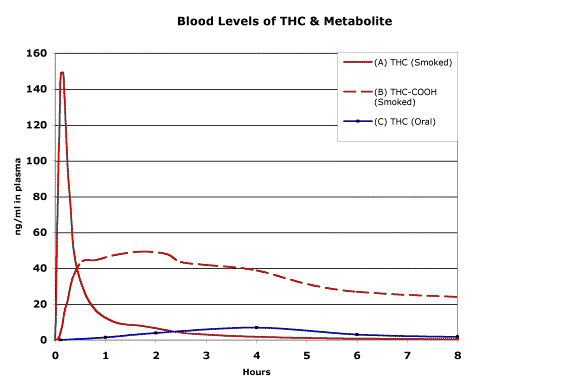
Third, THC levels in the blood spike soon after smoking and then drop quickly, while the effects can last for hours. A single THC number can't tell you how impaired someone is right now. These challenges complicate things for courts, law enforcement and employers.
In light of these issues, what's the right solution?
The CDC says cannabis affects the parts of the brain that control movement, balance, coordination, memory and judgment. Combining cannabis with alcohol makes impairment worse, and inexperienced users may not know their limits.
If measuring THC doesn't reveal impairment, another approach is to look at how a person's body is responding. Cannabis can affect reaction time, balance and eye movement, so some companies test for those signs instead.
One company taking this approach is Gaize. Its product runs automated eye-movement tests, based on the tests used by Drug Recognition Expert (DRE) officers, inside a self-contained virtual reality headset. According to the company, results take about 6 minutes, and it describes the product as an impairment screening tool rather than a drug test. Learn more by clicking the link below:
Gaize – The leading marijuana impairment detection technology.
Gaize is privately held, so its shares aren't traded on a stock exchange. Private companies typically raise money through private offerings, many of which are limited to accredited investors. Gaize states on its website that its test is more than 98% accurate, but we could not find an independent study confirming that figure.
What's the science behind Gaize?
Gaize builds on the eye-movement tests that Drug Recognition Experts already use. The difference is that the tests are run automatically and the headset records eye-tracking data and video throughout. The chart below illustrates why a single blood THC reading is a poor guide to impairment: THC spikes and falls quickly after smoking, while the effects last much longer.
Top Gaize facts you should know:
- Gaize lists offices in Missoula, Montana, and Philadelphia, Pennsylvania.
- The Gaize product uses a virtual reality headset to run automated eye-movement tests.
- Gaize markets to employers in safety-sensitive industries (such as construction, manufacturing and transportation) and to law enforcement.
- Since THC levels in the body don't reliably match impairment, a THC reading from breath, blood or saliva alone can't show whether someone is impaired right now.
- Gaize captures eye-tracking data and video during each test.
- Gaize reports its accuracy as more than 98%; that is a company claim.
- The test video can be reviewed later by officers or employers.
- The headset is self-contained and doesn't need a separate computer to run the test.
Conclusion: Cannabis impairment detection is a real need, and products that measure the body's response rather than THC levels address the core science problem. Gaize is one private company in this space. If you're considering any private startup, read the offering documents carefully, understand that you could lose your entire investment, and consider talking with a licensed financial professional.
Thanks for reading! We hope this answered your questions about investing in marijuana impairment testing, and why breathalyzers are not a good solution to this problem.
Sources
- Cannabis and Driving, Centers for Disease Control and Prevention
- State Medical Cannabis Laws, National Conference of State Legislatures
- Gaize, Gaize (company website)