
11 Great Passive Income Ideas
Contents
Passive income is money that keeps coming in with little ongoing effort once it’s set up. Knowing where to turn and how to spend your time can be challenging, though, so here are 11 ideas worth considering.
None of these are truly hands-off. You have to build the income stream first, and most need some maintenance to keep it flowing. Choose something you don’t hate, or you won’t put in the work.
Results vary widely, and many side projects earn little or nothing. Also plan for taxes: the IRS says gig and side income is taxable even if you don’t get a tax form for it.
1. Sell on Gumroad
Gumroad is a website that allows anyone to put together a piece of content and sell it. Think about a subject you know more about than almost anyone else. Think of what you’re passionate about. These are all good candidates for a Gumroad product. If you’re a bartender, write a guide on how to be a “Home Mixologist.” If you’re a landscaper, write a guide for “Zone 5 Shrubs that Flower.” You can go on and on.
Gumroad has no monthly fee. Its pricing page lists 10% + $0.50 per sale through your own links, and 30% when a new customer finds you through its Discover marketplace. You can also use affiliates to drive traffic to your product.
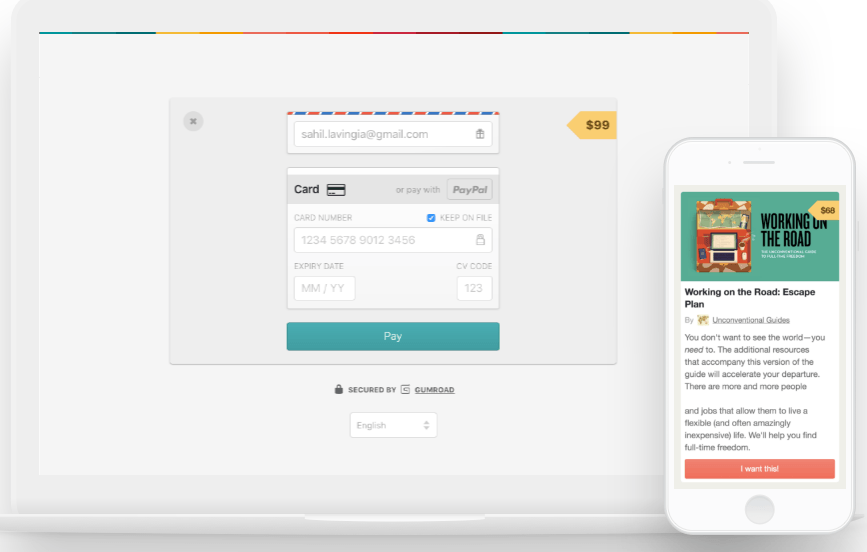
Below is a link to an example of a Gumroad product. As you’ll see, you can create a product for just about anything 😉
2. Create an Online Course
Hopefully you took the advice to create a Gumroad product and now have a developed piece of content on something that you know a lot about. Why not turn that Gumroad product into an online course? You can do just that with platforms like Thinkific, Coursera, and Udemy. These platforms are easy to use, though each has its own fees and revenue share, so compare them first. Courses are more work than some other options, but they can help people discover you as a subject matter expert. If you’ve ever taught something to someone else, you may know enough to make a course.
3. Create an Ebook
Maybe you created a course on Udemy or a Gumroad product. If so, you can certainly adopt that same content for book form and sell it on Amazon and other places. Amazon lets you self-publish in Kindle format and sell on its marketplace, which gives your book wide potential exposure. If you use several of these platforms, each one can drive sales to the others. Consider the strong and weak points of each format and find a way to send customers to other platforms. For example, you can use a Gumroad product to drive customers to a Thinkific course, and then use that course to drive Kindle book sales on Amazon.
4. Start a Podcast
Now that you’re an expert on a subject (see 1-3 above), you can take the next step and build a podcast which will attract an audience of like-minded people to listen. Regular, genuine content can attract sponsors once you have an audience, and it’s another way to send listeners to your ebook, course and Gumroad product.
Starting a podcast is straightforward, and the major platforms make it easy to submit your show. Be consistent, and get a decent microphone; bad audio drives listeners away fast.

5. Start a Substack Newsletter
You can start a Substack newsletter too, particularly if you’ve done any of the first four ideas in this list. Commit to a regular schedule and write content people want to read.
The math is simple but the work isn’t: 1,000 paid subscribers at $10 per month is $10,000 a month in gross revenue, before the platform’s cut and payment processing fees. Most newsletters take a long time to reach that many paying readers.
6. Start a Website
This website started as an income diversifying side hustle. You too can start a website and earn money on the side. The main ways to do it are affiliate links and advertising.
Affiliate links (like those found on this page) pay you a commission when a visitor you refer buys something, usually at no extra cost to the buyer. Advertising pays you based on your traffic, through ad views, clicks or both, depending on the ad network.
Pick a niche you enjoy, because you’ll spend a lot of time creating useful content before the site earns much. Income often takes many months of consistent work to show up, and many sites never earn much at all.
7. Create an Event
This is a love it or hate it industry, but there can be real money in events. If you’re good at organizing a lot of moving parts, and are detail oriented, event management may be for you. You can create anything, from an arts event to a music festival. Start small. For some quick, hypothetical math: if 10,000 people paid $20 to attend a local art and music festival, that’s $200,000 of revenue. If costs ate 50-75% of that, you’d keep $50,000 to $100,000.
Real first-year events often draw far fewer people, and venue, insurance, permits and talent costs can exceed ticket sales, so budget for a loss.
Every festival and event you see was started by someone, either with aspirations of making a little money, or just a lot of passion for the subject of the event. Events can be pop-up, or annual, depending on what you’re trying to make. The key though, is community. Make sure you engage with them early and often in an authentic way. You can build great events, it just takes a vision, and a lot of hustle.

8. Sell SEO / Social Media Services
Many small business owners don’t have the time or interest to build a website or manage social media. If you’re technically inclined, they may pay you to do it for them.
Search engine optimization takes longer to learn. Stay away from questionable tactics: search engines work hard to surface the best content, so use only white-hat techniques and focus on genuinely useful content. Social media management requires keeping up with how each platform’s algorithm works.
This is client work, not passive income, but retainer clients can provide steady recurring revenue.
9. Flip a Rental as an AirBnb
Starting a vacation rental business can be a great way to earn passive income. In some markets, short-term rental income can exceed what a place costs to rent long term. The idea is to rent a property in a location travelers want, furnish it, list it on Airbnb, and keep the difference after rent, cleaning, fees and furnishings.
Get the landlord’s written permission first; many leases prohibit subletting. Also check local rules before you start, since many cities require short-term rental permits, registration or taxes, and some ban non-owner-occupied rentals outright.
Occupancy can swing with the seasons, and you still owe rent when the place sits empty. Managing guests and cleanings is hands-on work.
10. Sell T-Shirts with Your Designs
If you’ve got an eye for design and can turn it into a print-ready file, you can sell T-shirts with your designs on them. Merch by Amazon is one example. You upload a design and earn a royalty when someone orders it, without ever handling the product.
Other sites to check out include Spreadshirt, Printify, and Teespring. Each platform has its own fees, royalty rates and rules, so compare them before you commit. Use only original designs; copying trademarked logos or characters can get your account shut down.
11. Personal Sales
It may not seem like passive income, but if you have an outgoing personality, personal sales can become a source of recurring income. Find a product you love from a small company and ask if you can be a sales rep on a commission-only basis.
Small companies are often more open to this than large ones, which tightly control how their products are sold. They get to focus on the product, and you earn money helping to sell it.
Negotiate a written deal that works for both of you. Ask for commissions on reorders from accounts you land; that recurring piece is what makes this semi-passive.
Avoid “opportunities” that require you to pay upfront, buy inventory or recruit others to earn. Those are signs of a business opportunity scam or a multilevel marketing program, not a sales job.
Don’t Forget Taxes
Most side income, including money paid in cash or crypto, has to be reported on your tax return. If your net earnings from self-employment are $400 or more, the IRS says you generally owe self-employment tax, currently 15.3% (12.4% Social Security plus 2.9% Medicare).
Set some of each payment aside for taxes, and consider a tax professional if your side income grows.
Sources
- Gig economy tax center, Internal Revenue Service
- Self-employment tax (Social Security and Medicare taxes), Internal Revenue Service
- Gumroad pricing, Gumroad