How To Avoid Merchant Credit Card Fees?
Contents
If you run a business, merchant credit card fees are one of the first costs worth reviewing. Each fee looks small, but across thousands of transactions they add up.
Some providers market programs to eliminate all credit card processing fees, mostly by shifting the cost to customers who pay by card. Here are the main ways to cut or offset merchant fees, and the rules to check first.
Use Surcharging Or Cash Discounts
Surcharges and cash discounts pass some or all of the card processing cost to the customer. The customer's choice of payment decides whether they pay extra or get a discount.
With surcharging, the processing fee is added to the price when the customer pays by credit card. For example, if a T-shirt costs $5 and the card fee is $0.10, a customer paying by credit card pays $5.10.
With a cash discount, the posted price covers the card cost, and customers who pay with cash get a discount instead.
Both approaches come with rules. Card networks limit how surcharges are set and disclosed, surcharges generally can't be added to debit card purchases, and some states restrict them. Confirm the rules with your payment processor and check your state's law before you start.
Change the Way You Accept Credit Cards
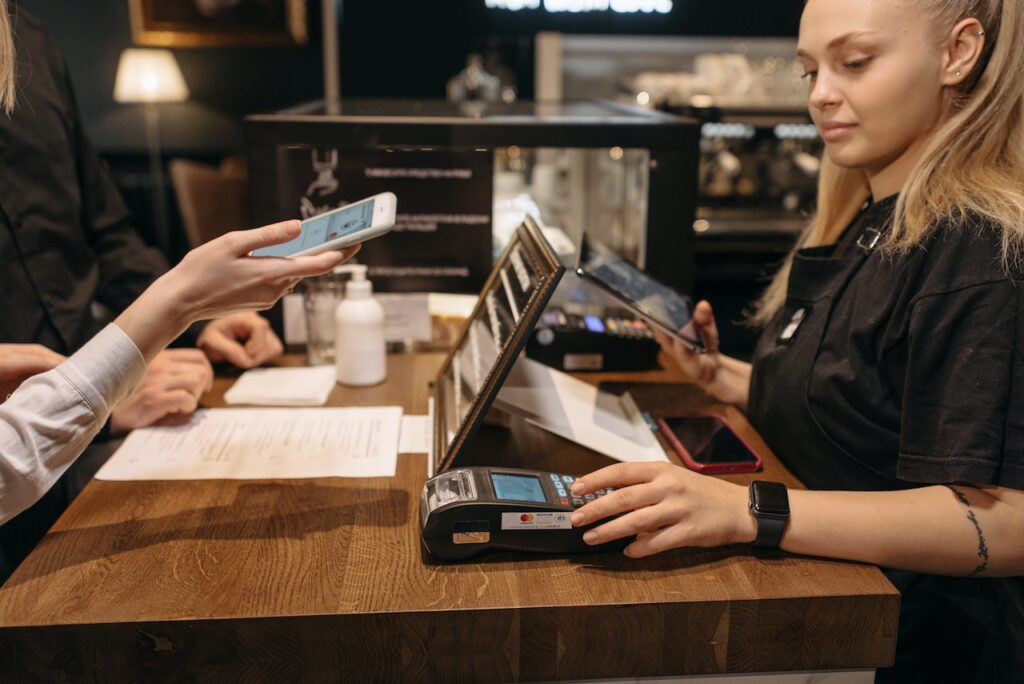
Many customers now pay by tapping a contactless card or a phone wallet at the register. To accept these payments, you need a point-of-sale (POS) terminal that supports contactless payments.
Contactless payments don't come with a special discount on their own. Ask your processor how in-person, keyed-in and online transactions are priced, because interchange fees can differ by card type, network and transaction type.
Debit cards are worth a look too. The Federal Reserve's Regulation II limits the interchange fees large debit card issuers can receive and lets merchants route debit transactions over any network the issuer has enabled. Ask whether your processor routes debit payments over the lowest-cost network.
Adopt Loyalty and Gift-Card Programs
Loyalty and gift-card programs encourage repeat customers and are easy to track. A gift card that only works at your business doesn't run through a card network when it's redeemed, so that sale carries no interchange fee.
That saving has limits. If a customer buys the gift card with a credit card, you still pay a processing fee on that purchase. Gift cards are also regulated at the federal and state level, so check the rules on expiration dates and leftover balances before you launch a program.
Review your processing statements every month and ask your provider which of these options fits your business. The right mix depends on your sales volume, your customers and your state.
Sources
- Regulation II (Debit Card Interchange Fees and Routing), Board of Governors of the Federal Reserve System
- Average Debit Card Interchange Fee by Payment Card Network, Board of Governors of the Federal Reserve System